Showing posts with label Class 10 Physics. Show all posts

NCERT Class 10 Science Chapter 12 Magnetic Effects of Electric Current Solutions

Magnetic Effects of Electric Current

NCERT TEXTBOOK Solutions for Class 10 Science

Question 1
Which of the following correctly describes the magnetic field near a long straight wire ?
(a) the field consists of straight lines perpendicular to the wire
(b) the field consists of straight lines parallel to the wire
(c) the field consists of radial lines originating from the wire
(d) the field consists of concentric circles centred on the wire

Answer: (d) The field consists of concentric circles centred on the wire

Question 2
At the time of short circuit, the current in the circuit
(a) reduces substantially
(b) does not change
(c) increases heavily
(d) vary continuously

Answer: (c) Increases heavily.

Question 3.
State whether the following statements are True or False.
(a) The field at the centre a long circular coil carrying current will be parallel straight lines.
(b) A wire with a green insulation is usually the live wire of an electric supply.

Answer:

(a) True
(b) False.

Question 4. List two methods of producing magnetic fields.

Answer: – Two methods of producing magnetic fields are:
(i)By using a current-carrying straight conductor.
(ii)By using a solenoid.

Question 5.
When is the force experienced by a current-carrying conductor placed in a magnetic field largest ?

Answer:
When the conductor carries current in a direction perpendicular to the direction of the magnetic field, the force experienced by the conductor is largest.

Question 6.
Imagine that you are sitting in a chamber with your back to one wall. An electron beam, moving horizontally from back wall towards the front wall, is deflected by a strong magnetic field to your right side. What is the direction of magnetic field ?

Answer:
Here the electron beam is moving from our back wall to the front wall, so the direction of current will be in the opposite direction, from front wall towards back wall or towards us. The direction of deflection (or force) is towards our right side.
We now know two things :

1. direction of current is from front towards us, and
2. direction of force is towards our right side.
Let us now hold the forefinger, middle finger and thumb of our left hand at right angles to one another. We now adjust the hand in such a way that our centre finger points towards us (in the direction of current) and thumb points towards right side (in the direction of force). Now, if we look at our forefinger, it will be pointing vertically downwards. Since the direction of forefinger gives the direction of magnetic field, therefore, the magnetic field is in the vertically downward direction.

Question 7.
State the rule to determine the direction of a (i) magnetic field produced around a straight conductor-carrying current (ii) force experienced by a current-carrying straight conductor placed in a magnetic field which is perpendicular to it, and (iii) current induced in a coil due to its rotation in a magnetic field.

Answer:

(i) Right hand thumb rule : If the current carrying conductor is held in the right hand such that the thumb points in the direction of the current, then the direction of the curl of the fingers will give the direction of the magnetic field.
(ii) Fleming’s left hand rule : Magnetic Effects of Electric Current Stretch the forefinger, the central finger and the thumb of the left hand mutually perpendicular to each other. If the forefinger points in the direction of the magnetic field, the middle finger in the direction of current, then the thumb points in the direction of force in the conductor.
(iii) Fleming’s right hand rule : Stretch the thumb, forefinger and the central finger of the right hand mutually perpendicular to each other. If the forefinger points in the direction of magnetic field, thumb in the direction of motion of the conductor, then the middle finger points in the direction of current induced in the conductor.

Question 8.
When does an electric short circuit occur ?

Answer:
In a domestic circuit, short-circuit occurs when live and neutral wire come in direct contact with each other without any resistance. The resistance of the circuit becomes zero and excessive current starts to flow through it.

Question 9.
What is the function of an earth wire ? Why is it necessary to earth metallic appliances ?

Answer:
Earth wire is a safety measure that provides a low resistance conducting path to the current. Sometimes due to excess heat or wear and tear, the live wire comes in direct contact with the metallic cover of the appliances, which can give an electric shock on touching them. To prevent from the shock the metallic part is connected to the earth through a three-pin plug due to which the current flows to the earth at the instant there is a short circuit.

It is necessary to earth metallic appliances because it ensures that if there is any current leakage in the metallic cover, the potential of the appliance becomes equal to that of the earth. The potential of the earth is zero. As a result, the person handling the appliance will not get an electric shock.


NCERT Intext Questions  for Class 10 Science Page Number: 196


Question 1
Why does a compass needle get deflected when brought near a bar magnet ?

Answer:
The magnetic field of the magnet exerts force on both the poles of the compass needle. The forces experienced by the two poles are equal and opposite. These two forces form a couple which deflects the compass needle.


NCERT Intext Questions  for Class 10 Science Page Number: 200


Question 1
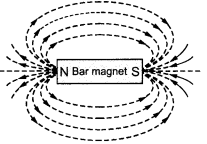
Draw magnetic field lines around a bar magnet.

Answer:
Question 2
List the properties of magnetic field lines.

Answer:

Properties of magnetic lines of force :

1. The magnetic field lines originate from the north pole of a magnet and end at its south pole.
2. The magnetic field lines become closer to each other near the poles of a magnet but they are widely separated at other places.
3. Two magnetic field lines do not intersect one another.

Q3. Why don’t two magnetic field lines intersect each other?

Answer:- If two magnetic field lines of force intersect each other then at the point of intersection, the compass needle would show two different directions which is not possible.


NCERT Intext Questions  for Class 10 Science Page Number: 201- 202


Question 1
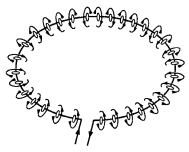
Consider a circular loop of wire lying on the plane of the table. Let the current pass through the loop clockwise. Apply the right hand rule to find out the direction of the magnetic field inside and outside the loop.

Answer:
As shown in figure alongside, each section of wire produces its concentric set of lines of force. By applying right hand thumb rule, we find that all the sections produce magnetic field downwards at all points inside the loop while at the outside points, the field is directed upwards. Therefore, the magnetic field acts normally into the plane of the paper at the points inside the loop and normally out of the plane of paper at points outside the loop.
Question 2
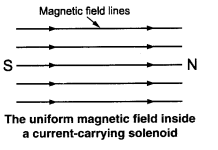
The magnetic field in a given region is uniform. Draw a diagram to represent it.

Answer:
A uniform magnetic field in a region is represented by drawing parallel straight lines, ail pointing in the same direction.
For example, the uniform magnetic field which exists inside a current-carrying solenoid can be represented by parallel straight lines pointing from its S-pole to N-pole (as shown in figure).
Question 3
Choose the correct option.
The magnetic field inside a long straight solenoid-carrying current

(a) is zero

(b) decreases as we move towards its end

(c) increases as we move towards its end

(d) is the same at all points

Answer:

(iv) Is the same at all points.


NCERT Intext Questions  for Class 10 Science Page Number: 203 – 204


Question 1
Which of the following property of a proton can change while it moves freely in a magnetic field. (There may be more than one correct answer.)

(i) Mass

(ii) Speed

(iii) Velocity

(iv) Momentum

Answer:

The correct options are (iii) velocity, (iv) momentum.

Question 2
In Activity 12.7 how do we think the displacement of rod AB will be affected if (i) current in rod AB is increased (ii) a stronger horse-shoe magnet is used; and (iii) length of the rod AB is increased ?

Answer:
(i) When the current in the rod AB is increased, force exerted on the conductor increases, so the displacement of the rod increases.

(ii) When a stronger horse-shoe magnet is used, the magnitude of the magnetic field increases. This increases the force exerted on the rod and the displacement of the rod.

(iii) When the length of the rod AB is increased, force exerted on the conductor increases, so the displacement of the rod increases.

Question 3
A positively-charged particle (alpha particle) projected towards west is deflected towards north by a magnetic field.
The direction of magnetic field is :

(i) towards south

(ii) towards east

(iii) downward

(iv) upward

Answer:

(iv) Upward.
Here, the positively charged alpha particles are moving towards west, so the direction of current is towards east. The deflection is towards north, so the force is towards north, so, we are given that
(i) direction of current is towards west
(ii) direction of force is towards north.
Let us now hold the forefinger, middle finger and thumb of our left-hand at right angles to one another. Adjust the hand in such a way that our mid finger points towards west (in the direction of current) and thumb points towards north (in the direction of force). Now, if we look at our forefinger, it will be pointing upward. Because the direction of forefinger gives the direction of magnetic field, therefore, the magnetic field is in the upward direction.


NCERT Intext Questions  for Class 10 Science Page Number: 205


Question 1
Name two safety measures commonly used in electric circuits and appliances.

Answer:

(i) Earthing and
(ii) Electric fuse.

Question 2
An electric oven of 2 kW power rating is operated in a domestic electric circuit (220 V) that has a current rating of 5 A. What result do you expect ? Explain.

Answer:

The electric oven draws a current given by

Thus the electric oven draws current much more than the current rating 5 A. That is the circuit is overloaded. Due to excessive current, the fuse wire will blow and the circuit will break.
What precautions should be taken to avoid the overloading of domestic electric circuits ?
To avoid the overloading of domestic electric circuits, the following precautions should be taken :

(i) The wires used in the circuit must be coated with good insulating materials like PVC, etc.
(ii) The circuit must be divided into different sections and a safety fuse must be used in each section.
(iii) High power appliances like air-conditioner, refrigerator, a water heater, etc. should not be used simultaneously.

Q3. What precaution should be taken to avoid the overloading of domestic electric circuits?

Answer : The precautions that should be taken to avoid the overloading of domestic circuits are as follows: Too many appliances should not be connected to a single socket. Too many appliances should not be used at the same time. Faulty appliances should not be connected in the circuit. Fuse should be connected in the circuit.
NCERT Class 10 Science Chapter 12 Magnetic Effects of Electric Current Solutions Magnetic Effects of Electric Current NCERT TEXTBOOK Solutio...

NCERT Class 10 Science Chapter 11 Electricity Solutions

Electricity

NCERT TEXTBOOK Solutions for Class 10 Science

1. A piece of wire of resistance R is cut into five equal parts. These parts are then connected in parallel. If the equivalent resistance of this combination is R′, then the ratio R/R′ is –

(a) 1/25 

(b) 1/5 

(c) 5 

(d) 25

Answer: (d) 25

2. Which of the following terms does not represent electrical power in a circuit?

(a) I2R

(b) IR2

(c) VI

(d) V2 / R

Answer:

(b)IR2

3. An electric bulb is rated 220 V and 100 W. When it is operated on 110 V, the power consumed will be –

(a) 100 W 

(b) 75 W

(c) 50 W 

(d) 25 W

Answer: (d) 25 W

4. Two conducting wires of the same material and of equal lengths and equal diameters are first connected in series and then parallel in a circuit across the same potential difference. The ratio of heat produced in series and parallel combinations would be –

(a) 1:2 

(b) 2:1 

(c) 1:4 

(d) 4:1

Answer: (c) 1:4

Q5. How is a voltmeter connected in the circuit to measure the potential difference between two points?

Answer: A voltmeter is always connected in parallel to the component across which potential difference is to be measured.

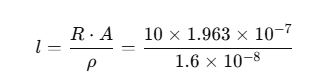
Q6. A copper wire has diameter 0.5 mm and resistivity of 1.6 × 10⁻⁸ Ω m. What will be the length of this wire to make its resistance 10 Ω? How much does the resistance change if the diameter is doubled?

Answer:

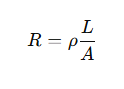
We know the formula for resistance:


ρ=1.6× 10⁻⁸ Ωm
𝑅=10 Ω
diameter 𝑑=0.5 mm = 0.0005 m
d=0.5 mm=0.0005 m,

radius 𝑟 = d2 =0.00025

So the cross-sectional area:

A=π r2 =π(0.00025)2 =1.963× 10⁻⁷ m2

Now,

l=122.7 m (approximately 123 m)

If the diameter is doubled:

New diameter
𝑑′=2×0.5 mm=1 mm=0.001 m

New radius
𝑟′=0.0005 m

New area:

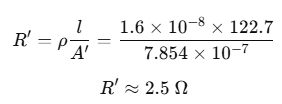
A′= π (0.0005)2 = 7.854 × 10⁻² m2

So,

Final Result:
Required length of wire = 123 m (approx.)
Resistance when diameter is doubled = 2.5 Ω

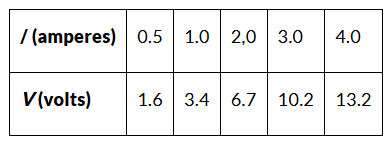
Q 7. The values of current I flowing in a given resistor for the corresponding values of potential difference V across the resistor are given below –

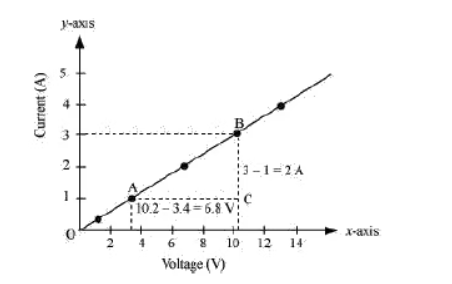
Answer: Plot a graph between V and I and calculate the resistance of that resistor. The plot between voltage and current is called IV characteristic. The voltage is plotted on x-axis and current is plotted on y-axis. The values of the current for different values of the voltage are shown in the given table

The IV characteristic of the given resistor is plotted in the following figure.

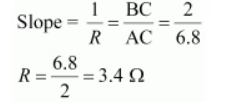
The slope of the line gives the value of resistance (R) as,

Therefore, the resistance of the resistor is 3.4 Ω.

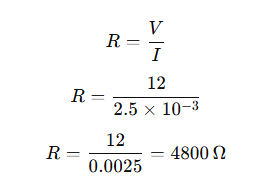
Q8. When a 12 V battery is connected across an unknown resistor, there is a current of 2.5 mA in the circuit. Find the value of the resistance of the resistor.
Answer: We are given:

Potential difference, V = 12 V
Current, I = 2.5 mA = 2.5 × 10⁻³ A

Using Ohm’s Law:

The resistance of the resistor is 4800 Ω (4.8 kΩ).

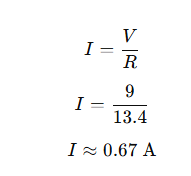
Q 9. A battery of 9 V is connected in series with resistors of 0.2 Ω, 0.3 Ω, 0.4 Ω, 0.5 Ω and 12 Ω, respectively. How much current would flow through the 12 Ω resistor?

Answer: Since all the resistors are connected in series, the total resistance is the sum of all individual resistances.
R=0.2+0.3+0.4+0.5+12
R=13.4 Ω
The total potential difference of the battery is
V=9 V

Using Ohm’s Law:

In a series circuit, the same current flows through all resistors.
Therefore, the current through the 12 Ω resistor is also 0.67 A.

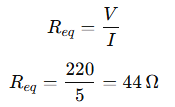
Q 10. How many 176 Ω resistors (in parallel) are required to carry 5 A on a 220 V line?

Answer: –

We are given:
Voltage, 𝑉=220
Current, 𝐼=5

Resistance of each resistor, 𝑅=176Ω

First, find the equivalent resistance required for the circuit using Ohm’s law:


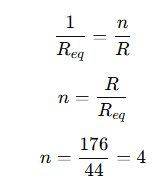
Now, for n,resistors of resistance R connected in parallel

4 resistors of 176 Ω in parallel are required.

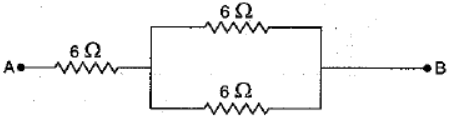
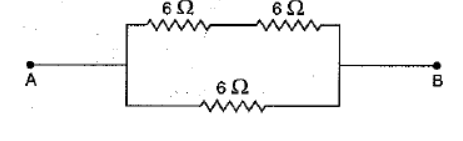
Q11: Show how you would connect three resistors, each of resistance 6 Ω so that the combination has a resistance of (i) 9 Ω, (ii) 4 Ω.

Ans:  (i) When two 6 Ω resistances are in parallel and the third is in combination with this, the equivalent resistance will be 9Ω.

(if) When two 6 Ω resistances are in series and the third is in parallel to them, then it will be 4 Ω.

Q 12.Several electric bulbs designed to be used on a 220 V electric supply line, are rated 10 W. How many lamps can be connected in parallel with each other across the two wires of 220 V line if the maximum allowable current is 5 A? 

Answer:  Power of each lamp = 10 W
Supply voltage = 220 V

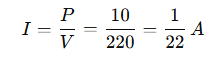
Current drawn by each lamp:

Maximum allowable current = 5 A

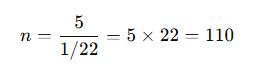
Number of lamps that can be connected in parallel:

Therefore, 110 lamps can be connected in parallel.

Q 12. A hot plate of an electric oven connected to a 220 V line has two resistance coils A and B, each of 24 Ω resistance, which may be used separately, in series, or in parallel. What are the currents in the three cases?

Answer: Resistance R1 of the bulb is given by the expression:

R1V2P

Supply voltage, 𝑉=220
Maximum allowable current, 𝐼=5
Rating of each bulb, P=10W

R1=220210 =4840Ω

According to Ohm’s law,
V=IR
Let R be the total resistance of the circuit for 𝑥 number of electric bulbs.
Since the bulbs are connected in parallel,

R=r1x =4840Ω

Q13. A hot plate of an electric oven connected to a 220 V line has two resistance coils A and B, each of 24 Ω resistance, which may be used separately, in series, or in parallel. What are the currents in the three cases?

Answer: Given RARB = 24 Ω . Use Ohm’s law I = VR.

(A) One coil used separately

Here the resistance R=24 Ω

I=22024 =9.1666… A≈9.17 A

(B) Two coils in series

Equivalent resistance RSeries =24+24=48 Ω.

I = 22048=4.5833… A≈4.58 A

(C) Two coils in parallel

1Rparallel = 124 + 124112 =Rparallel =12 Ω

I = 22012 =18.3333 A18.33 A

(All currents calculated using Ohm’s law and rounded to two decimal places.)

Q 14. Compare the power used in the 2 Ω resistor in each of the following circuits:
(i) a 6 V battery in series with 1 Ω and 2 Ω resistors, and
(ii) a 4 V battery in parallel with 12 Ω and 2 Ω resistors.

Answer:-

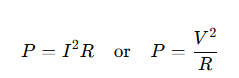
Power formula:

(i)6 V battery in series with 1 Ω 2 Ω resistor 

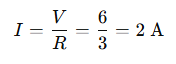
Total resistance: R=1+2=3Ω

Current in circuit:

Current through resistor = 2 A

Power in resistor :

P=I2R- (2)2 x 2 =8 W

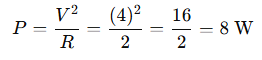
(ii) 4 V battery in parallel with 12 Ω and 2 Ω resistor

Voltage across each resistor in parallel = 4 V

Power in 2 Ω resistor:

Comparison
Power in case (i): 8 W
Power in case (ii): 8 W  

∴ The power used in the 2 Ω resistor is the same in both cases.

Q.15 Two lamps, one rated 100 W at 220 V, and the other 60 W at 220 V, are connected in parallel to electric mains supply. What current is drawn from the line if the supply voltage is 220 V?

Answer:-Step 1: Formula
The current drawn by each lamp is given by: I =PV

where = power of the lamp, and V= supply voltage.

Step 2: Current for 100 W lamp 

I1100220= 0.4545 A≈0.45 A

Step 3: Current for 60 W lamp

I260220=0.2727 A≈0.27 A

Step 4: Total current

Since the lamps are connected in parallel, the total current is the sum of the currents:

I=I1+ I2=0.45+0.27=0.72 A

Q16. Which uses more energy, a 250 W TV set in 1 hr, or a 1200 W toaster in 10 minutes?

Answer: We know,
Energy consumed (E)=Power (P)×Time (t)

For TV set:
P= 250 W , t  = 1h
E= 250 × 1 = 250 Wh

For toaster: P=1200W,t=10 minutes= 1060h =16h

E=1200 x 16 = 200 Wh

Comparison: 250Wh > 200Wh

Therefore, the 250 W TV set in 1 hour uses more energy than the 1200 W toaster in 10 minutes.

Q17. An electric heater of resistance 8 Ω draws 15 A from the service mains 2 hours. Calculate the rate at which heat is developed in the heater.

Answer:

We know,

Power (rate of heat developed)= I2R

Here,

I=15 A, R= 8 Ω
P= I2R (15)2 × 18
P=225 × 8= 1800W

Rate of heat developed in the heater = 1800 W (or 1.8 kW).

18. Explain the following.

(a) Why is the tungsten used almost exclusively for filament of electric lamps?
(b) Why are the conductors of electric heating devices, such as bread-toasters and electric irons, made of an alloy rather than a pure metal?
(c) Why is the series arrangement not used for domestic circuits?
(d) How does the resistance of a wire vary with its area of cross-section?
(e) Why are copper and aluminium wires usually employed for electricity
transmission

Answer: 

(a)Tungsten is used because it has a very high melting point (3380°C) and can withstand high temperatures without melting. It also emits light when heated to high temperature, making it suitable for lamp filaments.

(b) Alloys have higher resistivity than pure metals, so they produce more heat. They also do not oxidise or burn easily at high temperatures, which increases the life of the heating element.

(c) In a series circuit, the current is the same through all devices. If one appliance fails, the circuit is broken and all stop working. Also, different appliances need different current values, which cannot be supplied properly in series. Hence, domestic circuits use parallel arrangement.

(d) Resistance is inversely proportional to the area of cross-section of the wire.
R∝ 1A

(e) Copper and aluminium have very low resistivity and are good conductors of electricity. This allows easy flow of current with minimum power loss, which makes them ideal for transmission lines.


NCERT Intext Questions  for Class 10 Science Page Number: 172


Q1. What does an electric circuit mean?
Answer: An electric circuit means a continuous and closed path of an electric current.

Q2. Define the unit of current.
Answer: The unit of current is ampere (A). One ampere is the flow of one coulomb of charge per second, i.e.,
1 A = 1 C/1 s.

Q3. Calculate the number of electrons constituting one coulomb of charge.
Answer:

Charge on 1 electron = 1.6 × 10⁻¹⁹
Therefore, number of electrons in 1 C charge = 1 /(1.6 × 10-19 ) = 6× 10¹⁸  electrons (approximately)


NCERT Intext Questions  for Class 10 Science Page Number: 174


Q1. Name a device that helps to maintain a potential difference across a conductor.
Answer: A device that helps to maintain a potential difference across a conductor is a cell or a battery. The chemical action within the cell or battery produces the required potential difference.

Q2. What is meant by saying that the potential difference between two points is 1 V?
Answer: If the potential difference between two points is said to be 1 volt, it means that 1 joule of work is done in moving 1 coulomb of charge from one point to the other in an electric circuit.

Q3. How much energy is given to each coulomb of charge passing through a 6 V battery?

Answer:

The energy given to each coulomb of charge is calculated as:

Energy= Potential difference × Charge

Here, potential difference = 6 V, charge = 1 C

Energy=6×1=6joules

So, each coulomb of charge receives 6 joules of energy.


NCERT Intext Questions  for Class 10 Science Page Number: 181


Q1. On what factors does the resistance of a conductor depend?
Answer: The resistance of a conductor depends on:
(i) its length,
(ii) its area of cross-section, and
(iii) the nature of its material.

Q2. Will current flow more easily through a thick wire or a thin wire of the same material, when connected to the same source? Why?
Answer: Current will flow more easily through a thick wire because resistance is inversely proportional to the area of cross-section. A thick wire has less resistance than a thin wire.

Q3. Let the resistance of an electrical component remains constant while the potential difference across the two ends of the component decreases to half of its former value. What change will occur in the current through it?
Answer:According to Ohm’s law, current (I) = V/R.
If resistance is constant and potential difference is reduced to half, then the current will also become half of its initial value.

Q4. Why are coils of electric toasters and electric irons made of an alloy rather than a pure metal?
Answer:Alloys have higher resistivity and do not oxidise (burn) readily at high temperatures. Therefore, they are preferred over pure metals in devices like electric toasters and irons.

Q5. Use the data in Table 11.2 to answer the following –

(a) Which among iron and mercury is a better conductor?
Answer: Iron is a better conductor than mercury because it has lower resistivity.

(b) Which material is the best conductor?
Answer: Silver is the best conductor as it has the lowest resistivity.


NCERT Intext Questions  for Class 10 Science Page Number: 185


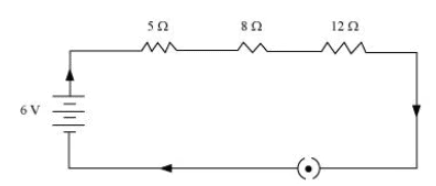
Q 1. Draw a schematic diagram of a circuit consisting of a battery of three cells of 2 V each, a 5 Ω resistor, an 8 Ω resistor, and a 12 Ω resistor, and a plug key, all connected in series.

Answer:- The circuit shows three 2 V cells in series (total emf = 6 V) connected through a plug key to three resistors of 5 Ω, 8 Ω and 12 Ω arranged end-to-end (in series). The wire returns to the negative terminal of the battery forming a closed loop.

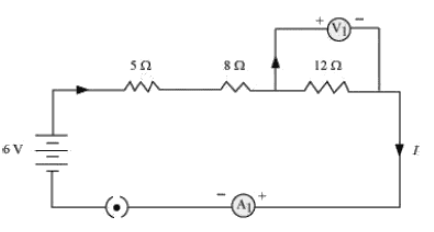
Q 2.Redraw the circuit of Question 1, putting in an ammeter to measure the current through the resistors and a voltmeter to measure the potential difference across the 12 Ω resistor. What would be the readings in the ammeter and the voltmeter?

Answer: – 


Step 1: Circuit Description

    • A battery of 3 cells of 2 V each total = 6 V.
    • Three resistors 5 Ω, 8 Ω, 12 Ω connected in series.
    • Ammeter: connected in series with the resistors (so it shows the same current through all).
    • Voltmeter: connected in parallel across the 12 Ω resistor.

Step 2: Total Resistance 

Rtotal =5+8+12=25Ω

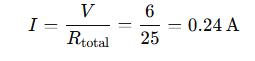
Step 3: Current in the Circuit (Ammeter Reading)


So, the ammeter reading = 0.24 A.

Step 4: Voltage Across 12 Ω Resistor (Voltmeter Reading)

V12  =I×R=0.24×12= 2.88 V

So, the voltmeter reading = 2.88 V.

Ammeter Reading = 0.24 A
Voltmeter Reading = 2.88 V


NCERT Intext Questions  for Class 10 Science Page Number: 188


Q1. Judge the equivalent resistance when the following are connected in parallel −
(a) 1 Ω and 10⁶ Ω
(b) 1 Ω and 10³ Ω and 10⁶ Ω

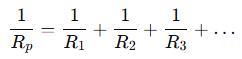
Answer: We know, for resistors in parallel:

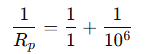
(a) For 1 Ω and 10⁶ Ω in parallel:


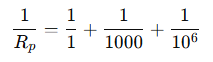
(b) For 1 Ω, 10³ Ω, and 10⁶ Ω in parallel:

(a) Equivalent resistance ≈ 1 Ω
(b) Equivalent resistance ≈ 1 Ω

Q2. An electric lamp of 100 Ω, a toaster of resistance 50 Ω, and a water filter of resistance 500 Ω are connected in parallel to a 220 V source. What is the resistance of an electric iron connected to the same source that takes as much current as all three appliances, and what is the current through it?

Answer: We are given

Lamp resistance R1 ​=100 Ω
Toaster resistance, R2 ​=50 Ω
Water filter resistance,R3 =500 Ω
Voltage, 𝑉=220

Step 1: Current through each appliance

(using Ohm’s law, I=VR

I1220100=2.2A

I222050​=4.4A

I3220500​=0.44A

Step 2: Total current taken by the three appliances

Itotal = I1+I2+I3
Itotal = 2.2+4.4+0.44=7.04A

Step 3: Resistance of the electric iron
If the iron takes the same current (7.04 A) from the same voltage (220 V):

R= VI2207.04 ≈31.25Ω

Step 4: Current through the iron
I=7.04A

Resistance of the electric iron = 31.25 Ω
Current through the electric iron = 7.04 A

Q 3. What are the advantages of connecting electrical devices in parallel with the battery instead of connecting them in series?

Answer: When electrical devices are connected in parallel with the battery, each device gets the same potential difference as the battery, so all appliances work properly. If one device fails, the others continue to operate independently. In parallel circuits, each device draws the current according to its resistance without affecting the other devices, and the overall resistance of the circuit is reduced, which allows a proper current supply.

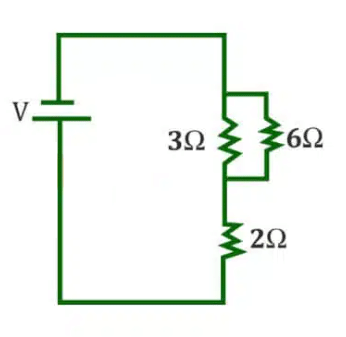
Q 4.How can three resistors of resistances 2 Ω, 3 Ω, and 6 Ω be connected to give a total resistance of (a) 4 Ω, (b) 1 Ω?

Answer:-
(a) To get 4 Ω:

  • First connect 3 Ω and 6 Ω in parallel.

IRp=13 +16 =2+16​= 3612

Rp=2Ω

    • Now connect this parallel resistance

Rp=2Ω in series with 2 Ω.

R =Rp+2-2+2-4 Ω
Thus, required combination is: 2 Ω in series with (3 Ω ∥ 6 Ω).


(b) To get 1 Ω:
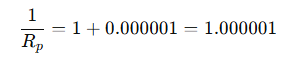
Connect 2 Ω, 3 Ω, and 6 Ω all in parallel.

IRp=12 +13 +16

IRp=3+2+16 –66 – 1

IRp= 1Ω
Thus, required combination is: 2 Ω ∥ 3 Ω ∥ 6 Ω.

Q 5.What is (a) the highest, (b) the lowest total resistance that can be secured by combinations of four coils of resistance 4 Ω, 8 Ω, 12 Ω, 24 Ω?

Answer:- (a) The highest total resistance is obtained when the four coils are connected in series.

Total resistance = 4 Ω + 8 Ω + 12 Ω + 24 Ω = 48 Ω.

(b) The lowest total resistance is obtained when the four coils are connected in parallel.

1R14 + 18 + 112 +124=12

So, 𝑅=2Ω
Thus, highest resistance = 48 Ω and lowest resistance = 2 Ω.


NCERT Intext Questions  for Class 10 Science Page Number: 190


Q1: Why does the cord of an electric heater not glow while the heating element does?

Answer: – The cord of an electric heater is made of metals like copper or aluminium, which have very low resistance, so very little heat is produced in them. The heating element is made of an alloy having much higher resistance. Since heat produced is given by 𝐻= I2Rt for the same current, heat is directly proportional to resistance. Therefore, the heating element produces much more heat and glows, while the cord does not.

Q.2. Compute the heat generated while transferring 96000 coulomb of charge in one hour through a potential difference of 50 V.

Answer:
Given:
Charge, 𝑄=96000
Potential difference, 𝑉=50𝑉
Time, 𝑡=1 ℎ𝑜𝑢𝑟= 3600 𝑠

2.We know that:
Work done (or Heat generated),
𝐻=𝑉×𝑄

Substituting the values:
𝐻=50×96000
𝐻=48,00,000𝐽

The heat generated is 4.8 × 10⁶ joules.

Q3: An electric iron of resistance 20Ω takes a current of 5 A. Calculate the heat developed in 30s.

Answer: – The amount of heat (H) produced is given by the joule’s law of heating as H= Vlt

Where,
Current, I = 5 A
Time, t = 30 s
Voltage, V = Current x Resistance = 5 x 20 = 100 V
H= 100 x 5 x 30 = 1.5 x 10⁴ J.

Therefore, the amount of heat developed in the electric iron 1.5 x 10⁴ J.


NCERT Intext Questions  for Class 10 Science Page Number: 192


Q1. What determines the rate at which energy is delivered by a current?

Answer:- The rate at which energy is delivered by a current is determined by the electric power, which is given by the product of current and potential difference
(P = VI).

Q2.An electric motor takes 5 A from a 220 V line. Determine the power of the motor and the energy consumed in 2 h.

Answer:-

Power of the motor:
Formula: P = V × I
Where: V = 220 V (voltage), I = 5 A (current)
P = 220 V × 5 A = 1100 W

Energy consumed in 2 h:
Formula: Energy = P × t
Where: P = 1100 W (power), t = 2 h = 2 × 3600 s = 7200 s
Energy = 1100 W × 7200 s = 7,920,000 J
Converting to kJ: 7,920,000 J / 1000 = 7920 kJ

.: Power = 1100 W, Energy = 7920 kJ

NCERT Class 10 Science Chapter 11 Electricity Solutions Electricity NCERT TEXTBOOK Solutions for Class 10 Science 1. A piece of wire of resi...

ADVERTISEMENT
×