Showing posts with label Class 8 Physics. Show all posts

NCERT Class 8 Science Chapter 16 Light Solutions


NCERT TEXT BOOK EXERCISES

Q. 1. Suppose you are in a dark room. Can you see objects outside the room? Explain.

Ans. When we are in a dark room then we do not see objects. We can see the objects outside the room because out of the room the light is available and that rays of light enter in our eyes after reflection.

Q. 2. Differentiate between regular and diffused reflection. Does diffused reflection mean the failure of the laws of reflection?

Ans.

Regular ReflectionDiffused Reflection
1. It takes place on a smooth surface.1. It takes place on a rough surface.
2. It has all the reflected rays in parallel.2. Reflected rays are not parallel.
3. Reflected rays are in one direction.3. Reflected rays are scattered in different directions. Diffused reflection is not due to failure of laws of reflection.

Diffused reflection is not due to the failure of the laws of reflection. It is caused by the irregularities in the reflecting surfaces.

Q. 3. Mention against each of the following whether regular or diffused reflection will take place when a beam of light strikes. Justify your answer in each case.

(a) Polished wooden table.

Ans. A polished wooden table will have regular reflection because its surface is smooth.

(b) Chalk powder.

Ans. A chalk powder will get the diffused reflection because chalk particles are not smooth. 

(c) Cardboard surface.

Ans. Cardboard surface has minute irregularities on it, so it will have a diffused reflection. 

(d) Marble stone with water spread over it.

Ans. Marble stone with water spread over it will have regular reflection if water is stable but if waves are formed then diffused reflection will take place. 

(e) Mirror.

Ans. A mirror will reflect light regularly due to its smooth surface.

(f) Piece of paper.

Ans. A piece of paper will have irregular reflection due to minute irregularities on it.

Q. 4. State the laws of reflection.

Ans. Following are the laws of reflection: 

(i) Incident ray, reflected ray and normal drawn at the point of incidence to the reflecting surface always lie in the same plane.

(ii) Angle of incidence is always equal to angle of reflection.

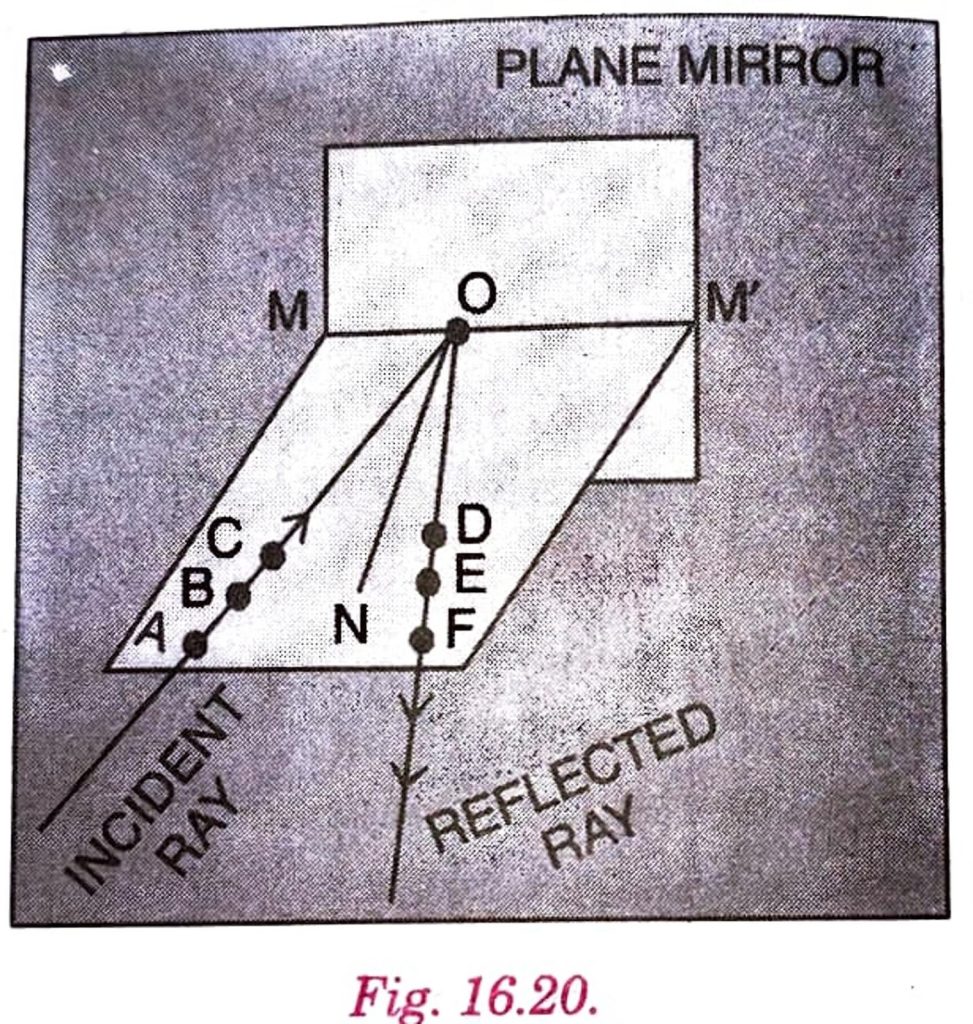
Q. 5. Describe an activity to show that the incident ray, the reflected ray and the normal at the point of incident lie in the same plane.

Ans. Take a white sheet, spread it on a table. Draw a line MM’ on it. Place a plane mirror vertically on this line. Now throw light on a comb in this ways that a parallel light rays fall on the mirror. Adjust it in such a way that a beautiful pattern of incident and reflected rays is formed. Now mark points A, B, C on incident ray and points D, E, F on its corresponding reflected ray. Switch off the torch and remove the mirror. Join the points and extend line ABC to meet MM’ at O and DEF will all also be meeting at O. OA is incident ray and OF is reflected ray. Draw ON ⊥ MM’. This shows that incident ray, reflected ray and normal, all lie in one plane.
Q. 6. Fill in the blanks in the following:

(a) A person 1 m in front of a plane mirror seems to be _________ m away from his image.

Ans. 2 m.

(b) If you touch your __________ ear with right hand in front of a plane mirror it will be seen in the mirror that your right ear is touched with __________.

Ans. left, left.

(c) The size of the pupil becomes _________ when you see in dim light.

Ans. increase.

(d) Night birds have __________ cones than rods in their eyes.

Ans. lesser.

Choose the correct option in the Questions 7-8. 

Q. 7. Angle of incidence is equal to the angle of reflection:

(i) Always.

(ii) Sometimes.

(iii) Under special conditions.

(iv) Never.

Ans. (i) Always.

Q. 8. Image formed by a plane mirror is:

(a) virtual, behind the mirror and enlarged.

(b) virtual, behind the mirror and of the same size as the object.

(c) real at the surface of the mirror and enlarged.

(d) real, behind the mirror and of the same size as the object.

Ans. (b) virtual, behind the mirror and of the same size as the object. 

Q. 9. Describe the construction of the human eye.

Ans. The kaleidoscope consists of three long and narrow strips of plane mirrors inclined at 60° to one another forming a hollow prism and fitted into a cardboard tube. One end of the cardboard tube is closed by an opaque disc (cardboard disc) having a small hole at its center. The other end of cardboard tube is closed with two circular discs of glass: the inner disc being of transparent glass and the other disc of ground glass. A number of small pieces of different coloured glass (or plastic) and having different shapes are kept between the two glass discs.

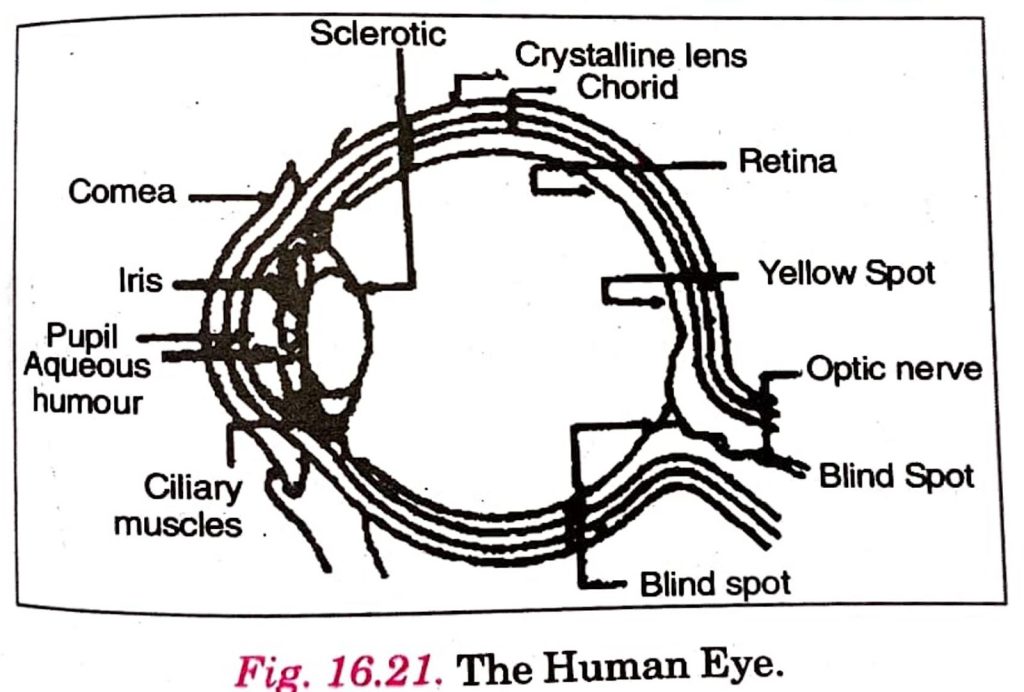
Q. 10. Draw a labeled sketch of the human eye.

Ans. Labeled diagram to show different parts of human eye.
Q. 11. Gurmit wanted to perform Activity 16.8 using a laser torch. Her teacher advised her not to do so. Can you explain the basis of the teacher’s advise?

Ans. Teacher has advised her to because laser light is harmful for eyes and can cause some permanent damage to eyes when throw directly in eyes.

Q. 12. Explain how you can take care of your eyes?

Ans. Following precautionary measures can be taken to take care of our eyes:

(i) We should atleast always wash our eyes with plane cold water atleast three times a day

(ii) We should not touch our eyes with dirty hands.

(iii) We should never rub our eyes.

(iv) We should not look at Sun directly.

(v) We should read book, watch T.V., read from black board from a suitable distance.

(vi) Consult an eye specialist if have any irritation, redness in the eyes.

Q. 13. What is the angle of incidence of a ray if the incident and reflected rays is at an angle of 90° to the incident ray?

Ans. The angle of incidence of the ray will be 45°.

Q. 14. How many images of a candle will be formed if it is placed between two parallel plane mirrors separated by 40 cm?

Ans. Infinite images will be formed.

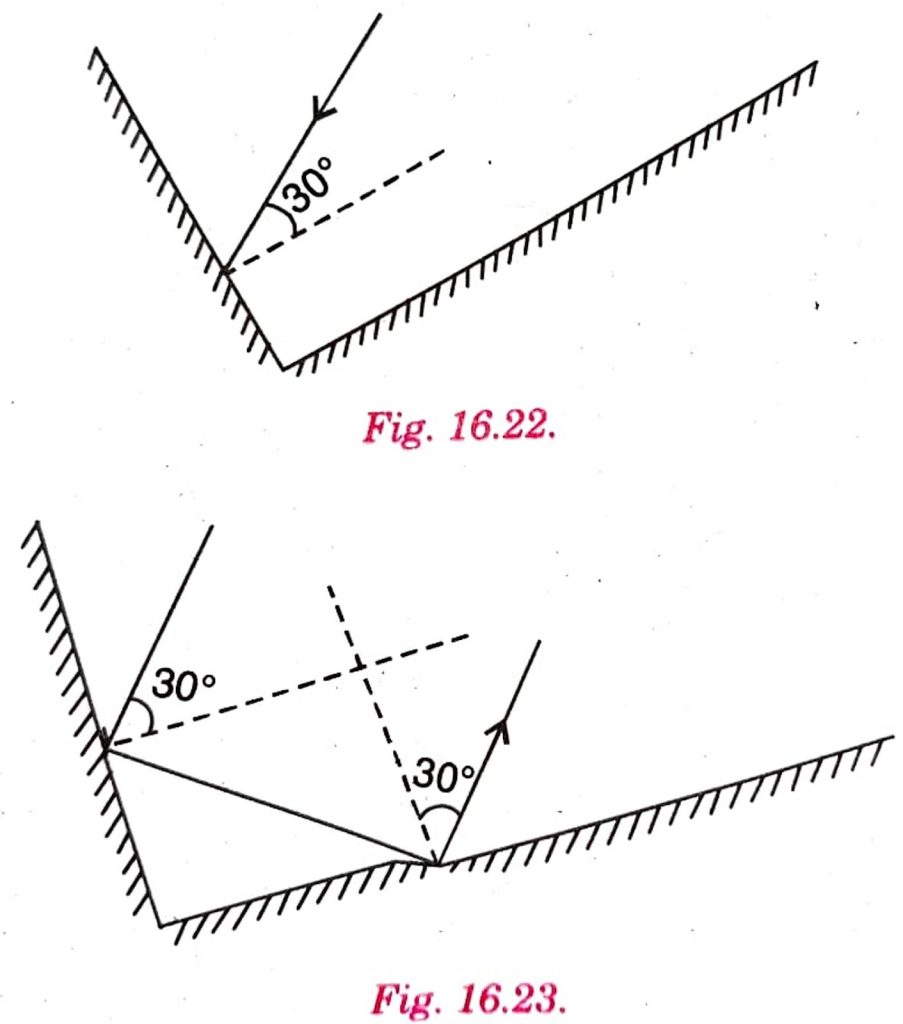
Q. 15. Two mirrors meet at right angles. A ray of light is incident on one at an angle of 30° as shown in the figure. Draw the reflected ray from the second mirror.

Ans.
Q. 16. Bhoojo stands at A just on the side of a plane mirror as shown in figure. Can he see himself in the mirror? Also can he see image of objects situated at P, Q and R?
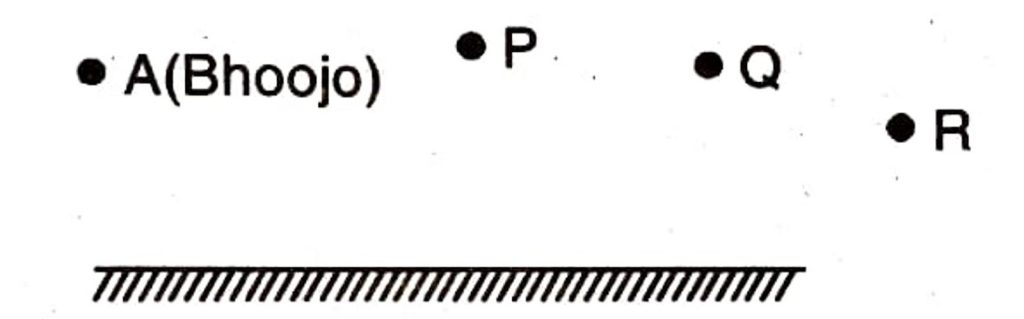
Ans. Bhoojo can’t see his image himself. He can see the images of objects at P but not Q and R.

Q. 17. (a) Find out the position of the image of an object situated at A in the plane mirror, (figure)
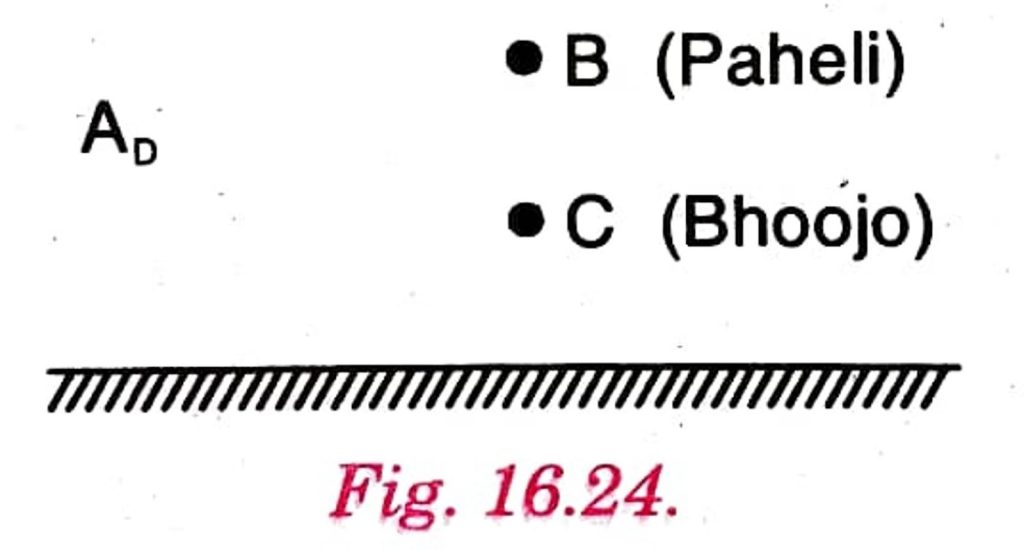
(b) Can Paheli at B see this image?

(c) Can Bhoojo at C see this image?

(d) When Paheli moves from B to C where does not the image of A move?

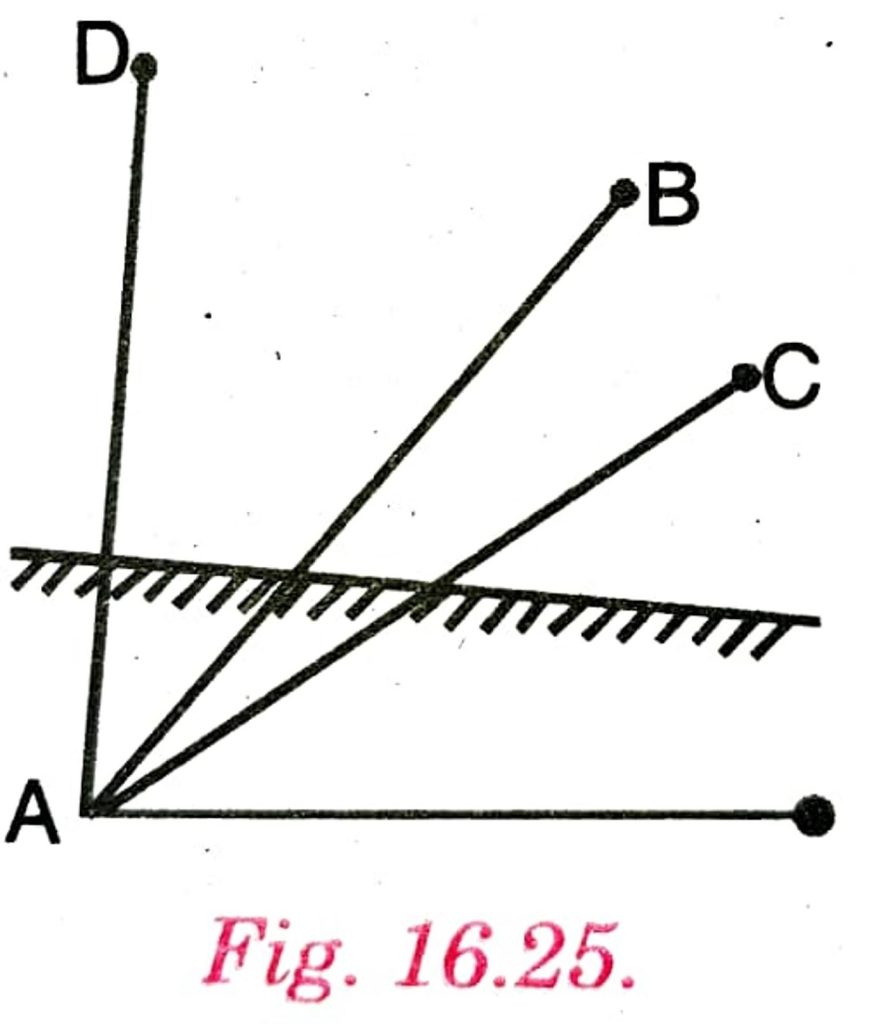
Ans. (b) Yes, Paheli can see the image at B.

(c) Yes, Bhoojo can see the image.

(d) No change of image A.
NCERT Class 8 Science Chapter 16 Light Solutions NCERT TEXT BOOK EXERCISES Q. 1. Suppose you are in a dark room. Can you see objects outside...

NCERT Class 8 Science Chapter 15 Some Natural Phenomena Solutions


NCERT TEXT BOOK EXERCISES

Select the correct option in Questions 1 and 2.

Q. 1. Which of the following cannot be charged easily by friction?

(a) A plastic scale.

(b) A copper rod.

(c) An inflated balloon.

(d) A woollen cloth.

Ans. (b) A copper rod.

Q. 2. When a glass rod is rubbed with a piece of silk cloth the rod

(a) and the cloth both acquire positive charge.

(b) becomes positively charged while the cloth has a negative charge.

(c) and the cloth both acquire negative charge

(d) becomes negatively charged while the cloth has a positive charge.

Ans. (b) becomes positively charged while the cloth has a negative charge.

Q. 3. Write T against true and F against false in the following statements:

(a) Like charges attract each other. (T/F)

Ans. False.

(b) A charged glass rod attract a charged plastic straw. (T/F)

Ans. True.

(c) Lightning conductor cannot protect a building from lightning. (T/F)

Ans. False

(d) Earthquakes can be predicted in advance (T/F)

Ans. False.

Q. 4. Sometimes, a crackling sound is heard while taking off sweater during winters. Explain.

Ans. The electric discharge takes place between body and sweater. At the time of electric discharge some energy is released. In this case energy is released in the form of crackling sound.

Q. 5. Explain why a charged body loses its charge if we touch it with our hand.

Ans. Human body is a conductor of electricity. When a body is touched with hand, the electric current of body passes to the earth through the body and body loses its charge.

Q. 6. Name the scale on which the destructive energy of an earthquake is measured. An earthquake measures 3 on this scale. Would it be recorded by a seismograph? Is it likely to cause much damage?

Ans. Destructive energy of an earthquake is measured in Richter Scale. Yes, it will be recorded by a seismograph. Earthquake with magnitude of 3 on Richter Scale is not much destructive. Such earthquakes do not cause any damage.

Q. 7. Suggest three measures to protect ourselves from lightning.

Ans. Three measures to stay protected from lightning are:

(i) Stay indoor or under covered area.

(ii) Don’t take bath during lightning.

(iii) We should not use T.V. or phone during lightning.

Q. 8. Explain why a charged balloon is repelled by another charged balloon whereas an uncharged balloon is attracted by another charged balloon?

Ans. A charged balloon is repelled by another charged balloon because both the balloons contain same type of charges. We know that like charges repel each other. A balloon is charged while other is uncharged, so they have no same charge. Therefore charged balloon attracts uncharged balloon.

Q. 9. Describe with the help of a diagram an instrument which can be used to detect a charged body.

Ans. Electroscope is used to detect electric charges or kind of charge on a body. It works on the principle that like charges repel and while unlike charges attract each other.

Charge a glass rod by rubbing its one end with a piece of silk cloth. Touch the charged glass rod with the top end of metal strip. We will see that the two aluminium leaves move away from each other. The two aluminium leaves having similar charges (positive charges) repel each other due to which they move apart.

Q. 10. List three states in India where earthquakes are more likely to strike. 

Ans. (i) Kashmir.

(ii) Rajasthan.

(iii) Gujarat.

Q. 11. Suppose you are outside your home and an earthquake strikes. What precautions would you take to protect yourself? 

Ans. (i) We should move to an open space. 

(ii) We should not take shelter under trees or buildings.

(iii) If we are driving, we should slow down the vehicle and move slowly away that area to a clear spot

Q. 12. The weather department has predicted that a thunder storm is likely to occur on a certain day. Suppose you have to go out on that day. Would you carry an umbrella? Explain.

Ans. No, we will not take an umbrella at the time of thunder storm. The taking of umbrella will increase the risk of lightning. The metal objects are more prone to lightning strike.

NCERT Class 8 Science Chapter 15 Some Natural Phenomena Solutions NCERT TEXT BOOK EXERCISES Select the correct option in Questions 1 and 2. ...

NCERT Class 8 Science Chapter 14 Chemical Effects of Electric Current Solutions


NCERT TEXT BOOK EXERCISES

Q. 1. Fill in the blanks:

(a) Most liquids that conduct electricity are solutions of _________ and __________.

Ans. acids and bases.

(b) The passage of an electric current through a solution causes ________ effect.

Ans. chemical.

(c) If you pass current through copper sulphate solution, copper gets deposited on the plate connected to the_____ terminal of the battery.

Ans. negative.

(d) The process of depositing a layer of any desired metal on another metallic object, by means of electricity, is called.

Ans. electroplating.

Q. 2. When the free ends of a tester are dipped into a solution, the magnetic needle shows deflection. Can you explain the reason?

Ans. The deflection of magnetic needle shows that the solution is a good conductor.

Q. 3. Name three liquids, which when tested in the manner shown in figure 14.11 may cause the magnetic needle to direct.

Ans. (i) Vinegar.

(ii) Lemon juice.

(iii) Common salt solution.

Q. 4. The bulb does not glow in the setup shown in figure 14.12. List the possible reasons. Explain your answer.

Ans. It is possible that:

(i) The connections of wires in the circuit may be loose.

(ii) The bulb may be fused.

(iii) The battery may be dead (all used up) 

(iv) The liquid may be a poor conductor (non-conductor) of electricity.

Q. 5. A tester is used to check the conduction of electricity through two liquids, labeled A and B. It is found that the bulb of the tester glows brightly for liquid A while it glows very dimly for liquid B. You would conclude that:

(i) liquid A is a better conductor than liquid B. 

(ii) liquid B is a better conductor than liquid A. 

(iii) both liquids are equally conducting.

(iv) conducting properties of liquid cannot be compared in this manner.

Ans. (i) liquid A is a better conductor than liquid B. 

Q. 6. Does pure water conduct electricity? If not, what can we do to make it conducting? 

Ans. Some salt can be added to it to make it a conductor.

Q. 7. In case of fire, before the firemen use the water hoses, they shut off the main electrical supply for the area. Explain why they do this.

Ans. Water is a good conductor of electric current. So, the firemen shut off the electric supply before spraying water to save themselves and other people from electrocution.

Q. 8. A child staying in the coastal region tests the drinking water and also the seawater with his tester. He finds that the compass needle deflects more in the case of seawater. Can you explain the reason?

Ans. Sea water contains a large amount of dissolved salts in it. Due to the presence of a large amount of dissolved salt in it, sea water is a much better conductor of electricity than drinking water which contains only a small amount of dissolved salts in it. The greater electric current passing through sea water produces stronger magnetic field in wire and hence deflects the compass needle more.

Q. 9. Is it safe for the electrician to carry out electrical repairs outdoors during heavy downpour? Explain.

Ans. No, it is highly dangerous to carry on electric repairs in water, as water is a good conductor of electricity. It can cause electrocution. 

Q. 10. Paheli had heard that rainwater is as good as distilled water. So she collected some rainwater in a clean glass tumbler and tested it using a tester. To her surprise she found that the compass needle showed deflection. What could be the reasons?

Ans. While it rains, the raindrops get mixed with the suspended particles of the air. So, they do not remain pure. It becomes the mixture of salts and other impurities thus shows conduction of electricity.

Q. 11. Prepare a list of objects around you that are electroplated.

Ans. Following objects around us are electroplated, rims of cycles, doorhandles, taps, showers, metallic pens, artificial jewellery, utensils, metallic almirahs, buckles of clothes and belts etc.

Q. 12. The process that you saw in Activity 14.7 is used for purification of copper. A thin plate of pure copper and a thick rod of impure copper are used as electrodes. Copper from impure rod is sought to be transferred to the thin copper plate. Which electrode should be attached to the positive terminal of the battery and why?

Ans. Thick rod of impure copper is to be attached to positive terminal of battery as pure copper moves to electrode connected to negative terminal of the battery.

NCERT Class 8 Science Chapter 14 Chemical Effects of Electric Current Solutions NCERT TEXT BOOK EXERCISES Q. 1. Fill in the blanks: (a) Most...

ADVERTISEMENT
×