
NCERT Class 6 Science Chapter 12 Question Answer Beyond Earth
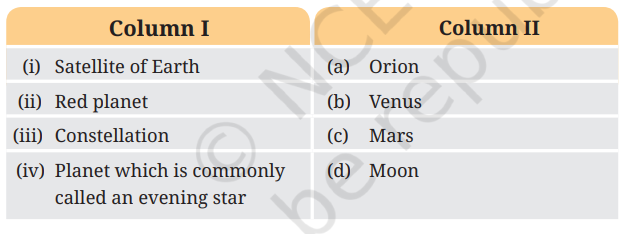
Question 1. Match the column:
Answer:
| Column I | Column II |
| (i) Satellite of Earth | Moon |
| (ii) Red planet | Mars |
| (iii) Constellation | Orion |
| (iv) Planet which is commonly called an evening star | Venus |
Question 2. (i) Solve the following riddle.
My first alphabet is in MAN but not in CAN
My second alphabet is in ACE and also in FAN
My third alphabet is in RAT and not in CAT
My fourth alphabet is in SUN but not in FUN
I am a planet that moves around the Sun.
(ii) Make two similar riddles by yourself.
(a) My first alphabet is in VAN but not in PAN
My second alphabet is in EARTH and also in HEAVEN
My third alphabet is in ONE and not in TWO
My fourth alphabet is in SUN and also in FUN
My last alphabet is in STAR but not in RADAR
I am a planet that moves around the Sun.
Answer: VENUS
(b) My first alphabet is in EAT but not in BAT
My second alphabet is in FAT and also in SAT
My third alphabet is in RAT and not in MAT
My fourth alphabet is in TEN and also in NET
My fifth alphabet is in HAT but not in PAT.
I am a planet that moves round the Sun.
Answer: EARTH
Question 3. Which of the following is not a member of our Solar System?
(i) Sirius
(ii) Comets
(iii) Asteroids
(iv) Pluto
Answer: (i) Sirius (It is a star outside the Solar System)
Question 4. Which of the following is not a planet of the Sun?
(i) Jupiter
(ii) Pluto
(iii) Neptune
(iv) Saturn
Answer: (ii) Pluto (It is now classified as a dwarf planet)
Question 5. Which is the brighter star, the Pole Star or Sirius?
Answer: Sirius is the brightest star in the night sky
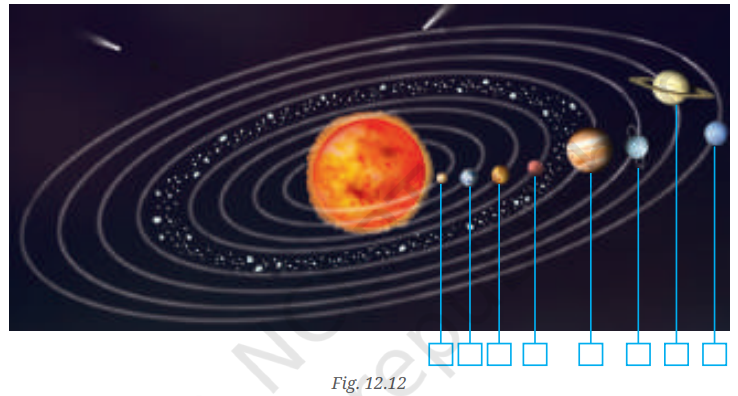
Question 6. An artist’s representation of the Solar System is given in Fig. 12.12. Is the order of the planets correct? If not, write the correct order in the boxes in the figure.
Answer:
The order of the planets in the figure is not correct. The correct order from the Sun is: Mercury, Venus, Earth, Mars, Jupiter, Saturn, Uranus and Neptune.
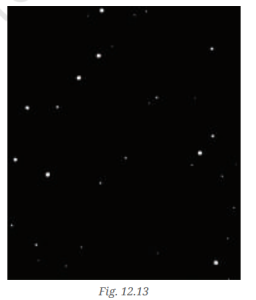
7. A portion of night sky with stars is shown in Fig. 12.13. Look carefully and identify the groups of stars that form the patterns—the Big Dipper and the Little Dipper. Draw lines to connect the stars for these patterns and label them. Also, identify and label the Pole Star. You may refer to Fig. 12.4 for help.
Answer:

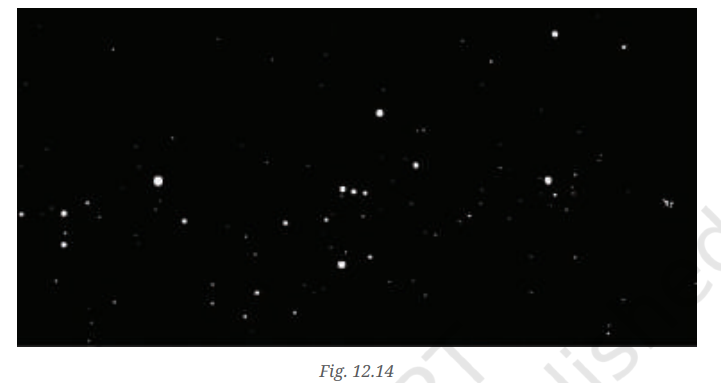
8. A portion of the night sky is shown in Figure. Draw lines to connect the stars for Orion and label the star Sirius. You may refer to Fig. 12.3.
Answer:
Orion is often represented as a hunter, with three stars forming his belt. Sirius, the brightest star in the sky, is located in the constellation Canis Major, which is close to Orion.
9. You can see stars fading away at dawn and appearing at dusk. During the day we do not see the stars. Explain why?
Answer:
We cannot see stars during the day because the brightness of the Sun’s light scatters in the atmosphere, overwhelming the faint light from distant stars
10. During a clear night, try to observe the Big Dipper 3-4 times at , an interval of 2 to 3 hours. Also try to locate the Pole Star each time. Does the Big Dipper appear to move? Draw a rough sketch to illustrate this, mentioning the time in each case.
Answer:
Yes, the Big Dipper appears to move across the sky due to the Earth’s rotation. Over a few hours, it will seem to shift position in the night sky. A rough sketch can be drawn showing the Big Dipper moving in an arc around the Pole Star as the night progresses.