Showing posts with label CBSE Class 6 Science. Show all posts

NCERT Class 6 Science Chapter 12 Question Answer Beyond Earth

Introduction

Class 6 Science Chapter 12 – Beyond Earth

Beyond Earth chapter mein students Earth ke bahar maujood space aur celestial objects ki fascinating duniya ke baare mein seekhte hain. Is chapter mein Sun, Moon, stars, planets aur Solar System jaise topics ko samajhne ka mauka milta hai.

Is chapter ke madhyam se students Solar System, planets ki movement, Moon ke phases, stars aur constellations jaise important concepts ko observations aur activities ke through samajhte hain. Yeh chapter students mein space aur universe ke prati curiosity develop karne aur scientific thinking ko badhava dene mein help karta hai.

Neeche diye gaye questions aur solutions ki madad se Beyond Earth chapter ko aasani se samjhein aur apni revision aur exam preparation ko behtar banayein.


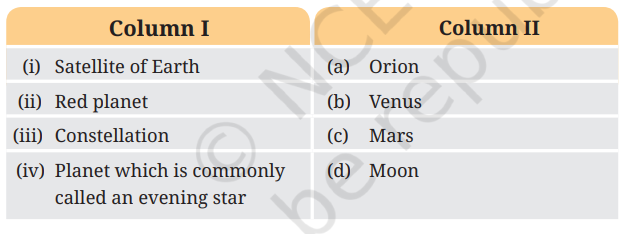
Question 1. Match the column:
Answer:

Column IColumn II
(i) Satellite of EarthMoon
(ii) Red planetMars
(iii) ConstellationOrion
(iv) Planet which is commonly called an evening starVenus


Question 2. (i) Solve the following riddle.

My first alphabet is in MAN but not in CAN
My second alphabet is in ACE and also in FAN
My third alphabet is in RAT and not in CAT
My fourth alphabet is in SUN but not in FUN
I am a planet that moves around the Sun.

Answer: (i) MARS

(ii) Make two similar riddles by yourself.

(a) My first alphabet is in VAN but not in PAN
My second alphabet is in EARTH and also in HEAVEN
My third alphabet is in ONE and not in TWO
My fourth alphabet is in SUN and also in FUN
My last alphabet is in STAR but not in RADAR
I am a planet that moves around the Sun.

Answer: VENUS

(b) My first alphabet is in EAT but not in BAT
My second alphabet is in FAT and also in SAT
My third alphabet is in RAT and not in MAT
My fourth alphabet is in TEN and also in NET
My fifth alphabet is in HAT but not in PAT.
I am a planet that moves round the Sun.

Answer: EARTH

Question 3. Which of the following is not a member of our Solar System?

(i) Sirius
(ii) Comets
(iii) Asteroids
(iv) Pluto

Answer: (i) Sirius (It is a star outside the Solar System)

Question 4. Which of the following is not a planet of the Sun?

(i) Jupiter
(ii) Pluto
(iii) Neptune
(iv) Saturn

Answer: (ii) Pluto (It is now classified as a dwarf planet)

Question 5. Which is the brighter star, the Pole Star or Sirius?

Answer: Sirius is the brightest star in the night sky

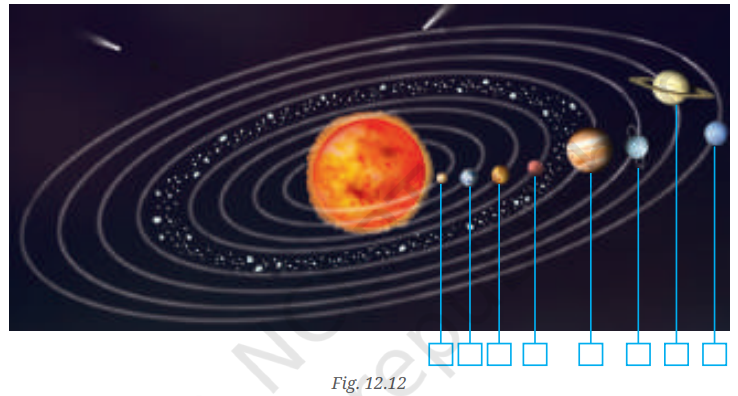
Question 6. An artist’s representation of the Solar System is given in Fig. 12.12. Is the order of the planets correct? If not, write the correct order in the boxes in the figure.
Answer:

The order of the planets in the figure is not correct. The correct order from the Sun is: Mercury, Venus, Earth, Mars, Jupiter, Saturn, Uranus and Neptune.

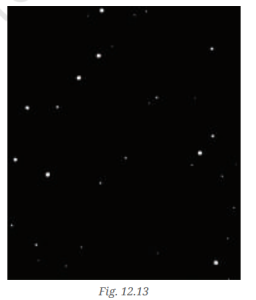
7. A portion of night sky with stars is shown in Fig. 12.13. Look carefully and identify the groups of stars that form the patterns—the Big Dipper and the Little Dipper. Draw lines to connect the stars for these patterns and label them. Also, identify and label the Pole Star. You may refer to Fig. 12.4 for help.
Answer:

8. A portion of the night sky is shown in Figure. Draw lines to connect the stars for Orion and label the star Sirius. You may refer to Fig. 12.3.
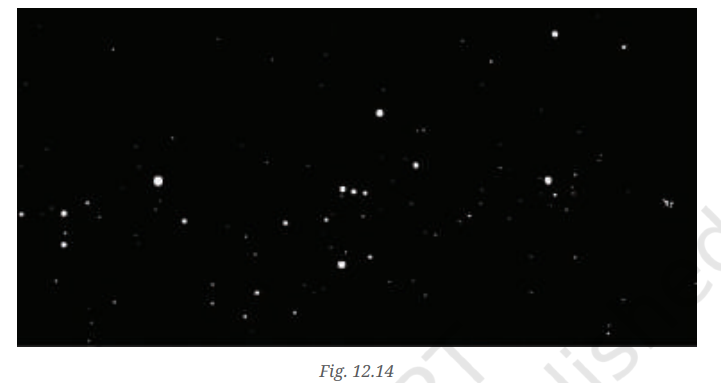
Answer:

Orion is often represented as a hunter, with three stars forming his belt. Sirius, the brightest star in the sky, is located in the constellation Canis Major, which is close to Orion​.

9. You can see stars fading away at dawn and appearing at dusk. During the day we do not see the stars. Explain why?

Answer:

We cannot see stars during the day because the brightness of the Sun’s light scatters in the atmosphere, overwhelming the faint light from distant stars​

10. During a clear night, try to observe the Big Dipper 3-4 times at , an interval of 2 to 3 hours. Also try to locate the Pole Star each time. Does the Big Dipper appear to move? Draw a rough sketch to illustrate this, mentioning the time in each case.

Answer:

Yes, the Big Dipper appears to move across the sky due to the Earth’s rotation. Over a few hours, it will seem to shift position in the night sky. A rough sketch can be drawn showing the Big Dipper moving in an arc around the Pole Star as the night progresses​.

📚 All Chapters:

NCERT Class 6 Science Chapter 12 Question Answer Beyond Earth Introduction Class 6 Science Chapter 12 – Beyond Earth Beyond Earth chapter ...

NCERT Class 6 Science Chapter 11 Question Answer Nature’s Treasures

Introduction

Class 6 Science Chapter 11 – Nature's Treasures

Nature's Treasures chapter mein students nature se milne wale different resources aur unki importance ke baare mein seekhte hain. Is chapter mein air, water, soil, forests aur other natural resources ke role ko samajhne par focus kiya gaya hai.

Is chapter ke madhyam se students natural resources ki importance, unka responsible use, conservation aur sustainability jaise important concepts ko samajhte hain. Saath hi, students yeh bhi seekhte hain ki nature ke resources ko protect karna aur unka wisely use karna hamari responsibility hai.

Neeche diye gaye questions aur solutions ki madad se Nature's Treasures chapter ko aasani se samjhein aur apni revision aur exam preparation ko behtar banayein.


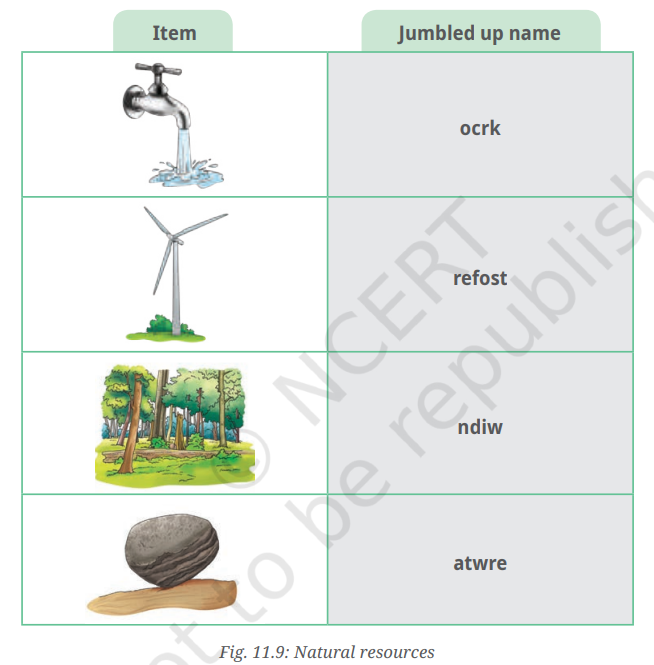
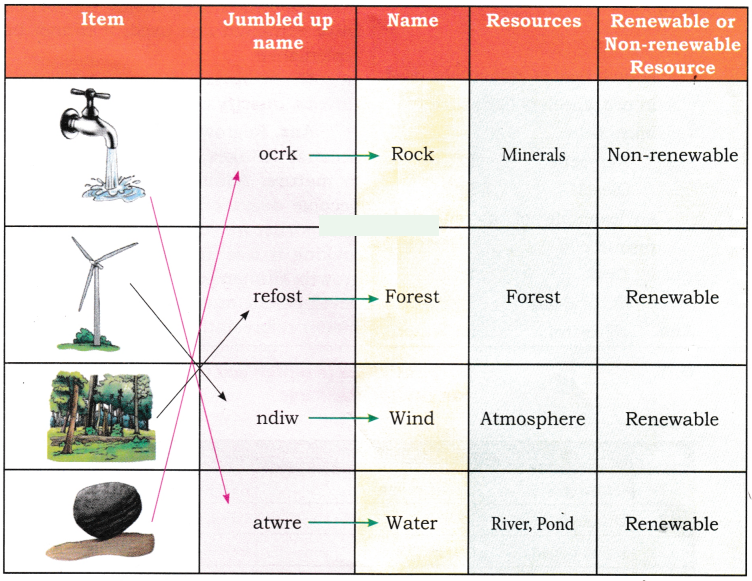
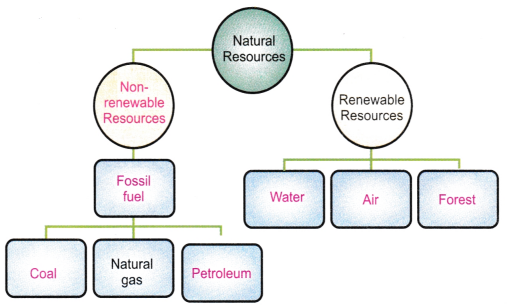
Question 1. Figure shows items related to natural resources. Match them with their jumbled up names. Make another table and write the names of these resources. Classify these resources as renewable or non-renewable.

Answer:

Question 2. State whether the following statements are True [T] or False [F]. If False, correct them.

(i) Nature has all the resources to meet human needs.

Answer:  True

(ii) Machines are a resource found in nature.

Answer:  False

Correct Statement:  Machines are human-made resources, not natural ones.

(iii) Natural gas is a non-renewable resource.

Answer:  True

(iv) Air is a renewable resource.

Answer:  True

Question 3. Fill in the blanks using the most appropriate option:

(i) A fuel that is commonly used in two wheelers like scooters or bikes is ______________

(a) Kerosene
(b) Petrol
(c) Diesel
(d) LPG

Answer: (b) Petrol

(ii) An example of a renewable resource is ______________

(a) Coal
(b) Water
(c) Natural gas
(d) Petrol

Answer: (b) Water

Question 4. Classify the following as renewable or non-renewable resources— coal, natural gas, forests and minerals.

Answer:

Coal: Non-renewable

Natural gas: Non-renewable

Forests: Renewable

Minerals: Non-renewable

Question 5. Why do we say that petroleum is a non-renewable resource?

Answer: Petroleum is considered non-renewable because it takes millions of years to form from the remains of ancient organisms, and once it is extracted and used, it cannot be replenished within a human lifetime.

Question 6. It is difficult to regrow forests. Justify this statement.

Answer: Forests take a long time to regenerate because trees grow slowly, and the complex ecosystems they support, including soil, animals, and plants, are difficult to restore once disturbed. Large-scale deforestation reduces biodiversity and affects soil quality​.

Question 7. Make a list of five daily activities in which you use natural resources. Suggest ways by which you can reduce their use.

Answer:

Daily ActivityNatural Resource UsedWays to Reduce use
1. CookingNatural gasUse solar cookers
2. Drinking waterWaterUse a water-efficient faucet
3. Using paperTrees (forests)Use digital documents
4. Using electricityCoal, natural gasUse energy-efficient appliances
5. Driving a carPetroleumUse public transport or cycle


Question 8. List four activities that are possible due to the presence of air.

Answer:

Four activities that are possible due to presence of air :-

  • Breathing (respiration)
  • Flying kites or paper planes
  • Wind energy generation
  • Pollination in plants through wind

Question 9. How can you contribute towards enhancing the green cover of your locality? Make a list of actions to be taken.

Answer:  List of actions to be taken

i) Participate in tree-planting drives.

ii) Encourage community members to plant more trees.

iii) Protect existing trees from being cut down.

iv) Use bio-friendly and sustainable gardening practices.

v) Create awareness about the importance of green cover.

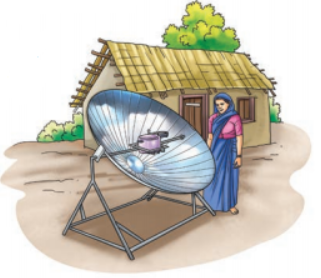
Question 10. In the given illustration, we see that food is being cooked.

Answer the following questions:

(i) What type of energy is being used for cooking?

(ii) Name one benefit and one drawback of using this type of energy for cooking.

Answer:

(i) Solar Energy

(ii) Benefit: Solar energy is a renewable and clean source of energy. Hence it is environment friendly.

Drawback: Dependence on Weather: Solar energy cannot be used during cloudy days or at night, which limits its reliability and convenience.

Question 11. Cutting down trees on a large scale impacts the quality of the soil. Why do you think it is so?

Answer:

Without trees, the soil can be washed away by rain, leading to the loss of fertile topsoil. Furthermore, fallen leaves from trees decompose and add organic matter to the soil, enhancing its fertility and structure. Cutting down trees impacts the quality of soil because tree roots help to bind the soil together, preventing erosion.

Question 12. Explain two ways in which human activities pollute the air. Propose one action which can help in reducing air pollution.

Answer:

Ways human activities pollute air:

    1. Burning fossil fuels in vehicles and factories releases harmful gases.
    2. Deforestation leads to the loss of plants that clean the air.

Action:  Promote and use public transport or electric vehicles to reduce vehicle emissions.

Question 13. A family uses solar panels to generate electricity, a gas stove to cook food, and a windmill for pumping water. What would happen if there were no sunlight for a week?

Answer:

Without sunlight, the solar panels would not generate electricity. This would force the family to rely on backup sources like the grid or alternative energy forms to meet their power needs​.

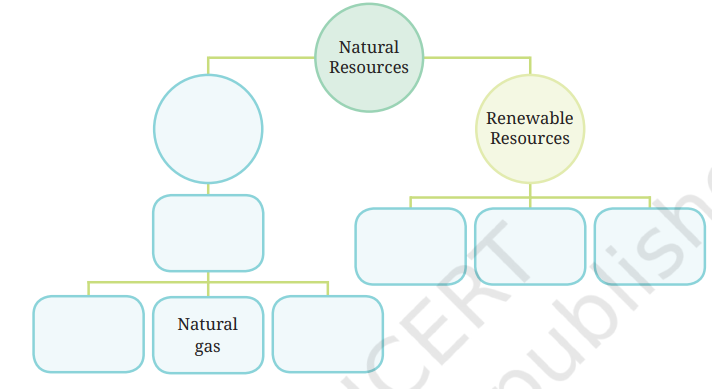
Question 14. Fill up the blanks using the following terms— [fossil fuels, forest, air, petroleum, coal, water and non-renewable resource)

Answer:

Question 15. Is the increasing demand for trees to meet the requirements of industries and housing justified? Discuss and prepare a brief report.

Answer:

No, it is not justified to cut down trees excessively. Forests are crucial for maintaining biodiversity, providing oxygen, and regulating the climate. Unchecked deforestation leads to loss of habitats, increased carbon dioxide levels, and soil erosion. Sustainable practices such as afforestation, controlled logging, and using alternative materials should be promoted.

Question 16. Propose a plan to use less water in your school. What steps would you take to make this plan happen and how would it help the environment?

Answer:

Plan to Use Less Water

  • Use grey water for gardening purposes.
  • Implement a rainwater harvesting system.
  • Install water-efficient faucets and toilets.

Steps to Implement the Plan

  • Monitor water usage regularly and set reduction targets.
  • Encourage student-led initiatives for water conservation.

Benefits: This will conserve water resources, reduce wastage, and lower the school’s water bills, while promoting environmental responsibility among students

📚 All Chapters:

NCERT Class 6 Science Chapter 11 Question Answer Nature’s Treasures Introduction Class 6 Science Chapter 11 – Nature's Treasures Nature...

NCERT Class 6 Science Chapter 10 Question Answer Living Creatures: Exploring their Characteristics

Introduction

Class 6 Science Chapter 10 – Living Creatures: Exploring their Characteristics

Living Creatures: Exploring their Characteristics chapter mein students living organisms ki basic characteristics ke baare mein seekhte hain. Is chapter mein living aur non-living things ke beech differences ko observe karke samajhne ki koshish ki jaati hai.

Is chapter ke madhyam se students growth, movement, respiration, nutrition, reproduction, response to stimuli aur living organisms ki anya important characteristics ko examples aur activities ke through samajhte hain. Yeh chapter students ko apne aas-paas ki living world ko scientific way mein observe karne mein help karta hai.

Neeche diye gaye questions aur solutions ki madad se Living Creatures: Exploring their Characteristics chapter ko aasani se samjhein aur apni revision aur exam preparation ko behtar banayein.


1. List the similarities and differences in life cycles of plants and animals.

Answer:

Aspect Plants AnimalsSimilarities
Beginning of Life CycleStarts from a seed.Starts from an egg/embryo or directly born.Both begin life as a simple form (seed/egg).
GrowthSeed germination, root and shoot development.Stages like embryo, infant, and adult.Both grow and increase in size and complexity.
Aspect Plants AnimalsDifferences
`Stages of LifeSeed → Seedling → Mature Plant → Flower/Fruit → Seed.Egg → Larva/Young → Adult.Plants are stationary, while animals are mobile.
End of Life CycleDeath after fruiting or after a certain period of maturity.Death after a certain lifespan, based on species.Plants produce their own food, while animals depend on others for food.


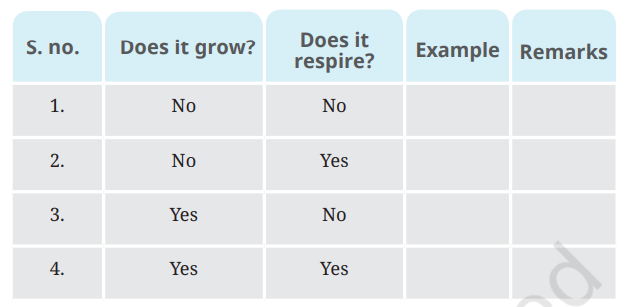
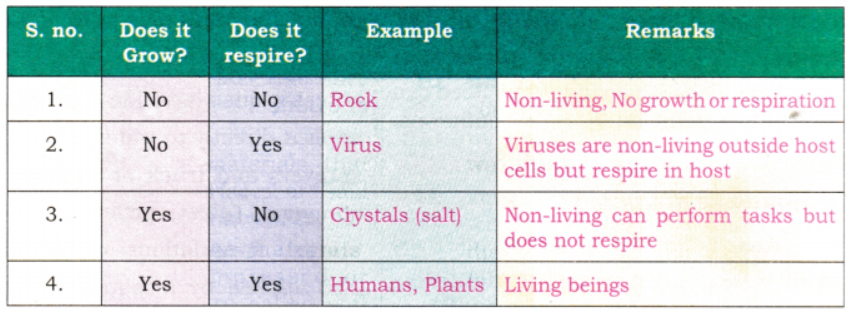
2. The table on the next page shows some data. Study the dataand try to find out examples appropriate for the conditions given in the second and third columns. If you think that an example for any of the conditions given below is not possible, explain why.

Answer:

3. You have learnt that different conditions are required for seed germination. How can we use this knowledge for proper storage of grains and pulses?

Answer: Proper storage of grains and pulses requires controlling moisture levels since water is essential for germination. Keeping the grains dry and in airtight containers prevents germination and fungal growth.

4. You have learnt that a tail is present in a tadpole but it disappears as it grows into a frog. What is the advantage of having a tail in the tadpole stage?

Answer: The tail helps tadpoles swim efficiently in water, which is essential for finding food and escaping predators in their aquatic environment.

5. Charan says that a wooden log is non-living as it cannot move. Charu counters it by saying that it is living because it is made of wood obtained from trees. Give your arguments in favour or against the two statements given by Charan and Charu.

Answer:

Arguments for and against Charan and Charu’s statements:

Charan’s Argument: A wooden log is non-living because it cannot perform essential characteristics of living things like movement, growth, respiration, and reproduction.

Charu’s Argument: While the wood comes from a tree that was once living, the log itself is no longer alive as it does not exhibit the characteristics of living beings, like growth and respiration, anymore.

6. What are the similarities and distinguishing features in the life cycles of a mosquito and a frog?

Answer:

  • frog –      Egg → Tadpole → Froglet → Adult
  • mosquito –      Egg → Larva → Pupa → Adult

Similarities:

  • Both go through stages of metamorphosis involving eggs, larval stages, and adult forms.
  • Significant changes in body shape and structure occur during their life cycles.

Differences:

  • Mosquito larvae live in water but develop into flying adults, while frog tadpoles live in water but become land-dwelling adult frogs.
  • Mosquito larvae and pupae require stagnant water, while frogs can live in more varied water bodies and spend part of their lives on land.

7. A plant is provided with all the conditions suitable for its growth (Fig. below). Draw what you expect to see in the shoot and the root of the plant after one week. Write down the reasons.

Answer:

The shoot will grow upward, and the roots will grow downward into the soil. The plant will show phototropism, where the shoot grows towards light and the roots exhibit geotropism, growing towards gravity.

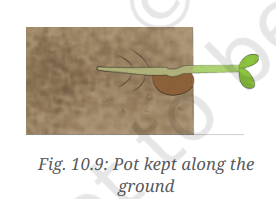
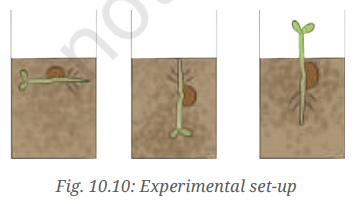
8. Tara and Vijay set up the experiment’ shown in the picture (Fig. below). What do you think they want to find out? How will they know if they are correct?

Answer:

Purpose of Tara and Vijay’s experiment:

They likely want to test how different environmental factors like light or water availability affect plant growth. They will know if they are correct by observing the differences in growth patterns in the plants subjected to different conditions.

Observation: If the shoot always grows upwards (towards the light) and the root always grows downwards (into the soil), regardless of how the seed is placed, this shows that plants have natural mechanisms (like phototropism and gravitropism) that guide their growth direction.

9. Design an experiment to check if temperature has an effect on seed germination.

Answer:

Take several pots, each containing the same type of seeds and soil. Keep the pots at different temperatures (e.g., in a warm room, cold room, and at room temperature). Monitor and record the germination rate in each condition to check how temperature influences seed sprouting.

Observation: Measure and compare the rate of germination and growth in different temperatures.
Conclusion: Determine the optimal temperature for seed germination based on observations.

📚 All Chapters:

NCERT Class 6 Science Chapter 10 Question Answer Living Creatures: Exploring their Characteristics Introduction Class 6 Science Chapter 10 ...

ADVERTISEMENT
×